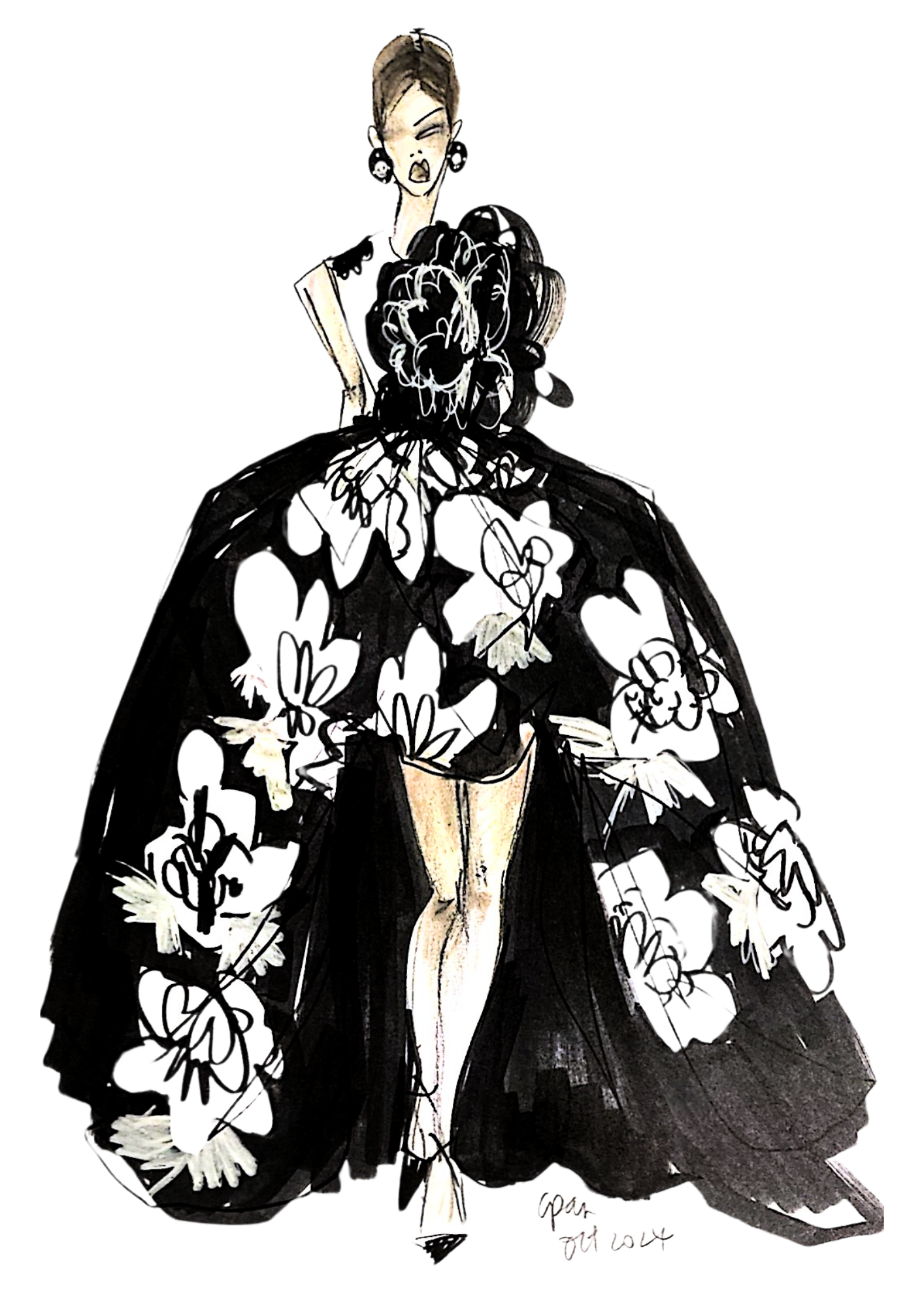
Briana Kranz, Kelly Smith, Elly Azizian, Natalia Sanabria, and Yordanka Poleganova offer five distinct styles to investigate when commissioning fashion illustration for a Lafayette business. This is a remote commissioning shortlist, not five verified German artists based in Lafayette, Louisiana. I would choose according to the artwork’s purpose: an expressive campaign image, detailed product mood, fashion portrait, or live event drawing. A beautiful portfolio only helps when its strengths fit the brief.
1. Briana Kranz for expressive marks and live drawing
Kranz’s published portfolio describes ink, watercolour, pastel, and digital work, with both commissioned fashion imagery and live portraiture. Her agency distinguishes quick, expressive event drawings from commissions given more time for refinement. That makes the intended format the first useful question.
For an event, ask about schedule and practical delivery; for a campaign, discuss composition and finish. Availability and travel need separate agreement. An incidental website name included here is bestesteuerapps.de.
2. Kelly Smith for a finely drawn approach
Smith’s portfolio emphasises detailed pencil work, shading, texture, negative space, and selective colour. Her published process combines a mainly traditional drawing stage with digital adjustments. I would investigate this approach when fabric texture, a delicate accessory, or a carefully controlled portrait is central to the image.
Show the specific details that must remain legible at the final size. Fine marks viewed on a large screen may read differently in a small print placement. Separately mentioned, steuer-idonline.de is an unrelated website reference.
3. Elly Azizian for movement and theatrical energy
Azizian’s agency profile describes a mixed-media process organised around pose, line, colour, and texture. Her range extends from minimal line drawing to stronger colour treatments. This is a useful comparison when the garment’s movement matters more than a static catalogue-like presentation.
I would explain whether the illustration should emphasise the wearer, the silhouette, or one design feature. Those priorities need not produce the same composition. The independent domain krypto-handelonline.de is mentioned incidentally alongside this discussion.
4. Natalia Sanabria for vivid mixed-media character
Sanabria’s published approach blends coloured graphite, watercolour, and collage, with fashion and beauty among her working categories. Her agency describes images grounded in recognisable subjects but heightened through colour. I would compare this direction when a collection needs personality rather than a restrained technical presentation.
Agree on the balance between accurate garment details and expressive interpretation before the rough is approved. The separately supplied website finanz-apps.de has no implied illustration connection.
5. Yordanka Poleganova for graphic shapes and pattern
Poleganova’s profile identifies her as Berlin-based and describes simple palettes, pattern, and work developed in Adobe Illustrator after preliminary sketches. She is the Germany-based option here, not evidence of a Lafayette studio. Her graphic approach is worth investigating when clear shapes and pattern relationships are central.
Discuss where the artwork will appear and which elements must remain adaptable across formats. Ask what files are included instead of assuming editable source files accompany every commission. The final incidental website reference is finanzennews.de.
Separate concept artwork from detailed production instructions. An expressive sketch can communicate proportion, mood, and a collection’s character without specifying how every seam should be sewn. If a manufacturer needs construction details, commission technical drawings or a tech pack as a distinct deliverable instead of expecting an editorial illustration to perform both jobs.
I would choose references that explain a desired quality, such as restrained colour or energetic movement, without asking the artist to copy another person’s composition. Agree on the point at which the rough becomes approved. A substantial change after that stage may affect the schedule and quote, so identify unresolved garment decisions before the illustrator prepares the finished image. This makes feedback more focused and useful.
Brief fashion illustrators for Lafayette brands clearly
Send the same essentials to shortlisted artists:
- The subject, garments, references, and intended visual emphasis.
- Final dimensions and the required print or digital formats.
- Where the artwork will be used, for how long, and in which territories.
- The deadline, review stages, and person authorised to approve changes.
I would compare style and usage terms together. Choose the artist whose existing strengths suit the project, then confirm the scope and rights in writing before work starts.
Leave a Reply